FAIR Guidance Vocabulary (FGV) — Core Ontology
Release: October 2025
- Modified on: 2026-10-01
- This version:
- https://w3id.org/fgv/1.0.0
- Latest version:
- https://w3id.org/fgv#
- Previous version:
- https://w3id.org/fgv/0.1.1
- Revision:
- 1.0.0
- Authors:
- Mike Priddy, KNAW-DANS
- Wilko Steinhoff, KNAW-DANS
- Wim Hugo, KNAW-DANS
- Contributors:
- Daniel Garijo, Universidad Politécnica de Madrid
- Mark Wilkinson, Universidad Politécnica de Madrid
- Pablo Alarcón, Universidad Politécnica de Madrid
- Allyson Lyster, University of Oxford
- Publisher:
- OSTrails
- Source:
- https://github.com/OSTrails/FAIR-Guidance-Vocabulary/tree/develop/release/1.0.0
- See also:
- https://doi.org/10.5281/zenodo.18506494
- https://docs.google.com/presentation/d/1t76YNBzeDmZSNqVFparUunX4v5EvN5DZrUjOOH7loqw
- Funder:
- European Commission
- Funding:
- European Union’s Horizon Europe framework programme under grant agreement No. 101130187
- Download serialization:




- License:

- Visualization:

- Cite as:
- https://orcid.org/0000-0002-0255-5101, https://orcid.org/0000-0002-7874-0362, https://orcid.org/0000-0003-1106-8441. FAIR Guidance Vocabulary (FGV) — Core Ontology. Revision: 1.0.0. Retrieved from: https://w3id.org/fgv/1.0.0
- Vocabulary maintained at:
- https://github.com/OSTrails/FAIR-Guidance-Vocabulary
Abstract
The FAIR Guidance Vocabulary (FGV) is an OWL/RDFS ontology and reference model for representing guidance associated with FAIR assessment in a structured and machine-actionable form. Guidance encompasses different forms of advice, including guidelines, recommendations, best practices, standards, FAQs and procedures, and may be provided directly by assessment tools and services or through external resources. FGV describes the type and focus of Guidance Elements and supports their linkage to online resources, provenance information and maturity values. By providing dereferenceable concepts as Linked Open Data, FGV enables guidance to be consistently described, shared, understood and reused across assessment tools and services. Although developed primarily to support automated FAIR assessment, the model is extensible and can also be applied to guidance associated with other principles, policies, protocols and assessment frameworks.Introduction back to ToC
Guidance is a broad and multifaceted concept, ranging from informal advice to formally governed standards. Research communities provide guidance in many forms, including guidelines, recommendations, best practices, standards, FAQs and procedures, supporting researchers, repository managers and other stakeholders in creating, managing and sharing research digital objects. The need for structured guidance is particularly apparent in the context of the FAIR Principles. Since their publication in 2016, numerous manual and automated FAIR assessment approaches have emerged. While the FAIR Principles were deliberately formulated to be broadly applicable, their practical interpretation may require further clarification and domain-specific guidance. FAIR assessment tools differ considerably in the guidance they provide: some offer practical information on improving FAIRness, while others primarily report assessment results or technical diagnostic information. Relevant guidance may also exist independently in disciplinary resources, community standards and dedicated FAIR guidance services. This motivated the development of the FAIR Guidance Vocabulary (FGV) within the EU-funded OSTrails project. FGV provides a reference model and vocabulary for describing practical guidance in a structured, machine-actionable form, enabling guidance to be classified, shared, linked and reused across tools, services and assessment frameworks. Guidance may be provided directly or referenced through external resources such as persistent identifiers, Web pages, annotations or service APIs. The model also supports provenance, focus, domain and maturity information. FGV was originally developed to complement the FAIR Test Results (FTR) vocabulary and support FAIR assessment, but is not restricted to FAIR. It can be used or extended for guidance associated with other principles, policies, protocols and assessment frameworks. Wherever possible, FGV reuses established vocabularies and metadata models to support interoperability.Namespace declarations
| fgv | <https://w3id.org/fgv#> |
| dcat | <http://www.w3.org/ns/dcat#> |
| dcterms | <http://purl.org/dc/terms/> |
| dqv | <http://www.w3.org/ns/dqv#> |
| foaf | <http://xmlns.com/foaf/0.1/> |
| owl | <http://www.w3.org/2002/07/owl#> |
| prov | <http://www.w3.org/ns/prov#> |
| rdf | <http://www.w3.org/1999/02/22-rdf-syntax-ns#> |
| rdfs | <http://www.w3.org/2000/01/rdf-schema#> |
| schema | <https://schema.org/> |
| sio | <http://semanticscience.org/resource/> |
| skos | <http://www.w3.org/2004/02/skos/core#> |
| xml | <http://www.w3.org/XML/1998/namespace> |
| xsd | <http://www.w3.org/2001/XMLSchema#> |
FAIR Guidance Vocabulary (FGV): Overview back to ToC
This ontology has the following classes and properties.Classes
- Annotation
- Benchmark
- Best Practice
- Focus Area
- Framework
- Frequently Asked Questions
- Guidance Element
- Guideline
- Instruction
- Maturity Value
- Object or Service / API
- Persistent Identifier
- Procedure
- Reference / External Resource
- Standard
- Web Page
Object Properties
- agent
- domain
- has focus area
- has maturity value
- has ordered instructions
- in dimension
- is manifested as
- location
- resolves to
- was revision of
Named Individuals
FAIR Guidance Vocabulary (FGV): Description back to ToC
The FAIR Guidance Vocabulary (FGV) is an OWL/RDFS ontology for describing, classifying and linking practical guidance in a structured and machine-actionable form. It models different types of Guidance Elements, such as recommendations, best practices, procedures, benchmarks and standards, and enables their characterisation by aspects including focus, domain, provenance and maturity. Guidance can be provided directly or manifested through External Resources, such as persistent identifiers, Web pages, annotations and service APIs. Originally developed within the OSTrails project to complement the FAIR Test Results (FTR) vocabulary and support FAIR assessment, FGV is designed for broader reuse with other principles, policies, protocols and assessment frameworks, while reusing established vocabularies and ontologies to support semantic interoperability. The conceptual schema below provides an overview of the main FGV classes and their relationships, including the external vocabularies and ontologies reused by FGV.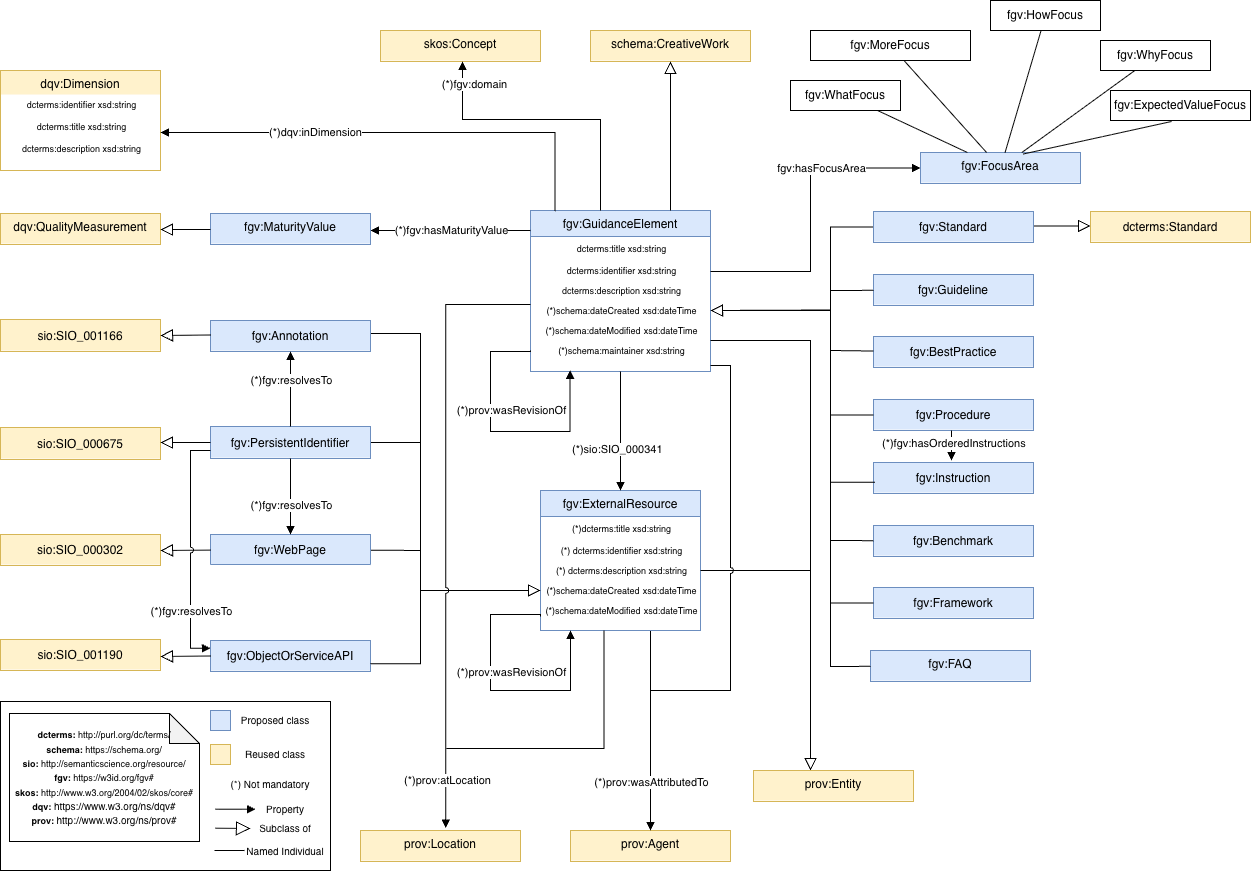
Cross-reference for FAIR Guidance Vocabulary (FGV) classes, object properties and data properties back to ToC
This section provides details for each class and property defined by FAIR Guidance Vocabulary (FGV).Classes
- Annotation
- Benchmark
- Best Practice
- Focus Area
- Framework
- Frequently Asked Questions
- Guidance Element
- Guideline
- Instruction
- Maturity Value
- Object or Service / API
- Persistent Identifier
- Procedure
- Reference / External Resource
- Standard
- Web Page
Annotationc back to ToC or Class ToC
IRI: https://w3id.org/fgv#Annotation
- has super-classes
- Reference / External Resource c, S I O 001166 c
- is in range of
- resolves to op
Benchmarkc back to ToC or Class ToC
IRI: https://w3id.org/fgv#Benchmark
- has super-classes
- Guidance Element c
Best Practicec back to ToC or Class ToC
IRI: https://w3id.org/fgv#BestPractice
- has super-classes
- Guidance Element c
Focus Areac back to ToC or Class ToC
IRI: https://w3id.org/fgv#FocusArea
- is in range of
- has focus area op
- has members
- Expected Value ni, How ni, More ni, What ni, Why ni
Frameworkc back to ToC or Class ToC
IRI: https://w3id.org/fgv#Framework
- has super-classes
- Guidance Element c
Frequently Asked Questionsc back to ToC or Class ToC
IRI: https://w3id.org/fgv#FAQ
- has super-classes
- Guidance Element c
Guidance Elementc back to ToC or Class ToC
IRI: https://w3id.org/fgv#GuidanceElement
- has super-classes
- Creative Work c, Entity c
- has sub-classes
- Benchmark c, Best Practice c, Framework c, Frequently Asked Questions c, Guideline c, Instruction c, Procedure c, Standard c
- is in domain of
- domain op, has focus area op, has maturity value op, in dimension op
Guidelinec back to ToC or Class ToC
IRI: https://w3id.org/fgv#Guideline
- has super-classes
- Guidance Element c
Instructionc back to ToC or Class ToC
IRI: https://w3id.org/fgv#Instruction
- has super-classes
- Guidance Element c
Maturity Valuec back to ToC or Class ToC
IRI: https://w3id.org/fgv#MaturityValue
- has super-classes
- Quality Measurement c
- is in range of
- has maturity value op
Object or Service / APIc back to ToC or Class ToC
IRI: https://w3id.org/fgv#ObjectOrServiceAPI
- has super-classes
- Reference / External Resource c, S I O 001190 c
- is in range of
- resolves to op
Persistent Identifierc back to ToC or Class ToC
IRI: https://w3id.org/fgv#PersistentIdentifier
- has super-classes
- Reference / External Resource c, S I O 000675 c
- is in domain of
- resolves to op
Procedurec back to ToC or Class ToC
IRI: https://w3id.org/fgv#Procedure
- has super-classes
- Guidance Element c
- is in domain of
- has ordered instructions op
Reference / External Resourcec back to ToC or Class ToC
IRI: https://w3id.org/fgv#ExternalResource
- has super-classes
- Entity c
- has sub-classes
- Annotation c, Object or Service / API c, Persistent Identifier c, Web Page c
Standardc back to ToC or Class ToC
IRI: https://w3id.org/fgv#Standard
- has super-classes
- Guidance Element c, Standard c
Web Pagec back to ToC or Class ToC
IRI: https://w3id.org/fgv#WebPage
- has super-classes
- Reference / External Resource c, S I O 000302 c
- is in range of
- resolves to op
Object Properties
- agent
- domain
- has focus area
- has maturity value
- has ordered instructions
- in dimension
- is manifested as
- location
- resolves to
- was revision of
agentop back to ToC or Object Property ToC
IRI: http://www.w3.org/ns/prov#wasAttributedTo
domainop back to ToC or Object Property ToC
IRI: https://w3id.org/fgv#domain
- has domain
- Guidance Element c
- has range
- Concept c
has focus areaop back to ToC or Object Property ToC
IRI: https://w3id.org/fgv#hasFocusArea
- has domain
- Guidance Element c
- has range
- Focus Area c
has maturity valueop back to ToC or Object Property ToC
IRI: https://w3id.org/fgv#hasMaturityValue
- has domain
- Guidance Element c
- has range
- Maturity Value c
has ordered instructionsop back to ToC or Object Property ToC
IRI: https://w3id.org/fgv#hasOrderedInstructions
in dimensionop back to ToC or Object Property ToC
IRI: http://www.w3.org/ns/dqv#inDimension
- has domain
- Guidance Element c
- has range
- Dimension c
is manifested asop back to ToC or Object Property ToC
IRI: http://semanticscience.org/resource/SIO_000341
locationop back to ToC or Object Property ToC
IRI: http://www.w3.org/ns/prov#atLocation
resolves toop back to ToC or Object Property ToC
IRI: https://w3id.org/fgv#resolvesTo
has characteristics: functional
- has domain
- Persistent Identifier c
- has range
- Annotation c or Object or Service / API c or Web Page c
was revision ofop back to ToC or Object Property ToC
IRI: http://www.w3.org/ns/prov#wasRevisionOf
Named Individuals
Expected Valueni back to ToC or Named Individual ToC
IRI: https://w3id.org/fgv#ExpectedValueFocus
- belongs to
- Focus Area c
Howni back to ToC or Named Individual ToC
IRI: https://w3id.org/fgv#HowFocus
- belongs to
- Focus Area c
Moreni back to ToC or Named Individual ToC
IRI: https://w3id.org/fgv#MoreFocus
- belongs to
- Focus Area c
Whatni back to ToC or Named Individual ToC
IRI: https://w3id.org/fgv#WhatFocus
- belongs to
- Focus Area c
Whyni back to ToC or Named Individual ToC
IRI: https://w3id.org/fgv#WhyFocus
- belongs to
- Focus Area c
Legend back to ToC
op: Object Properties
ni: Named Individuals
Changes from last version
Classes
Modified classes
- https://w3id.org/fgv#Annotation
- Deleted: DisjointClasses DisjointClasses(<https://w3id.org/fgv#Annotation> <https://w3id.org/fgv#WebPage>)
- Deleted: DisjointClasses DisjointClasses(<https://w3id.org/fgv#Annotation> <https://w3id.org/fgv#PersistentIdentifier>)
- https://w3id.org/fgv#ExternalResource
- Added: rdfs:comment " A resource that represents or provides access to a piece of guidance, such as a Persistent Identifier, Web Page, Annotation, or Object/Service API. "@en
- Added: SubClass of http://www.w3.org/ns/prov#Entity
- Deleted: SubClass of http://semanticscience.org/resource/SIO_000614
- Deleted: rdfs:comment "A resource that represents or provides access to a piece of guidance. May be a Persistent Identifier, a Web Page, or an Annotation."@en
- https://w3id.org/fgv#FocusArea
- Added: rdfs:comment "The aspect of a Guidance Element addressed by the guidance, such as what it concerns, why it is relevant, how it can be applied, additional information, or an expected value."@en
- Deleted: rdfs:comment "A conceptual aspect or interpretive dimension describing the emphasis of a guidance element — typically answering 'What?', 'How?', or 'Why?'."@en
- https://w3id.org/fgv#GuidanceElement
- Added: SubClass of http://www.w3.org/ns/prov#Entity
- https://w3id.org/fgv#ObjectOrServiceAPI
- Added: SubClass of https://w3id.org/fgv#ExternalResource
- https://w3id.org/fgv#PersistentIdentifier
- Deleted: DisjointClasses DisjointClasses(<https://w3id.org/fgv#Annotation> <https://w3id.org/fgv#PersistentIdentifier>)
- Deleted: DisjointClasses DisjointClasses(<https://w3id.org/fgv#PersistentIdentifier> <https://w3id.org/fgv#WebPage>)
- https://w3id.org/fgv#WebPage
- Deleted: DisjointClasses DisjointClasses(<https://w3id.org/fgv#Annotation> <https://w3id.org/fgv#WebPage>)
- Deleted: DisjointClasses DisjointClasses(<https://w3id.org/fgv#PersistentIdentifier> <https://w3id.org/fgv#WebPage>)
Added classes
- http://www.w3.org/1999/02/22-rdf-syntax-ns#List
- http://www.w3.org/ns/dqv#Dimension
- http://www.w3.org/ns/dqv#QualityMeasurement
- http://www.w3.org/ns/prov#Agent
- http://www.w3.org/ns/prov#Entity
- http://www.w3.org/ns/prov#Location
- https://w3id.org/fgv#Guideline
- Added: SubClass of https://w3id.org/fgv#GuidanceElement
- https://w3id.org/fgv#Instruction
- Added: SubClass of https://w3id.org/fgv#GuidanceElement
- https://w3id.org/fgv#MaturityValue
- Added: SubClass of http://www.w3.org/ns/dqv#QualityMeasurement
Deleted classes
Object Properties
Modified object properties
- http://semanticscience.org/resource/SIO_000341
- Added: rdfs:comment "Relates a guidance element or an abstract external resource to its manifestation as a concrete external resource (e.g., PID, WebPage, or Annotation)."@en
- Deleted: domain https://w3id.org/fgv#ExternalResource
- Deleted: FunctionalObjectProperty FunctionalObjectProperty(<http://semanticscience.org/resource/SIO_000341>)
- Deleted: rdfs:comment "Relates an abstract reference to its single manifestation (e.g., PID, WebPage, or Annotation)."@en
- Deleted: Range https://w3id.org/fgv#ExternalResource
- https://w3id.org/fgv#domain
- Deleted: FunctionalObjectProperty FunctionalObjectProperty(<https://w3id.org/fgv#domain>)
- https://w3id.org/fgv#hasFocusArea
- Added: rdfs:comment "Relates a guidance element to a focus area addressed by the guidance."@en
- Deleted: FunctionalObjectProperty FunctionalObjectProperty(<https://w3id.org/fgv#hasFocusArea>)
- Deleted: rdfs:comment "Relates a guidance element to one of its focus areas (What, How, or Why)."@en
- https://w3id.org/fgv#resolvesTo
- Added: rdfs:seeAlso http://www.w3.org/ns/dcat#accessURL
- Added: domain https://w3id.org/fgv#PersistentIdentifier
- Added: Range Union of (https://w3id.org/fgv#Annotation, https://w3id.org/fgv#ObjectOrServiceAPI, https://w3id.org/fgv#WebPage)
- Deleted: Range Union of (https://w3id.org/fgv#ExternalResource, https://w3id.org/fgv#ObjectOrServiceAPI)
- Deleted: domain Union of (https://w3id.org/fgv#Annotation, https://w3id.org/fgv#PersistentIdentifier)
Added object properties
- http://www.w3.org/ns/dqv#inDimension
- Added: domain https://w3id.org/fgv#GuidanceElement
- Added: Range http://www.w3.org/ns/dqv#Dimension
- http://www.w3.org/ns/prov#atLocation
- http://www.w3.org/ns/prov#wasAttributedTo
- http://www.w3.org/ns/prov#wasRevisionOf
- https://w3id.org/fgv#hasMaturityValue
- Added: Range https://w3id.org/fgv#MaturityValue
- Added: domain https://w3id.org/fgv#GuidanceElement
- https://w3id.org/fgv#hasOrderedInstructions
- Added: domain https://w3id.org/fgv#Procedure
- Added: Range http://www.w3.org/1999/02/22-rdf-syntax-ns#List
Deleted object properties
Data Properties
Acknowledgments back to ToC
The authors would like to thank Silvio Peroni for developing LODE, a Live OWL Documentation Environment, which is used for representing the Cross Referencing Section of this document and Daniel Garijo for developing Widoco, the program used to create the template used in this documentation.